Your SDS was compliant once. Is it still?
Why Safety Data Sheet compliance is a risk management question, not just a regulatory one, and what a fast diagnostic can reveal that a standard audit cannot.
August 5, 2026 by Fiona Moir
Most Safety Data Sheets begin as a good-faith effort at compliance: a regulatory professional, a software tool, a process. The document is checked, approved, and distributed. And then, typically, it is not touched again for years.
The problem is not negligence. It is a mismatch between the pace of regulatory change and the operational reality of maintaining a large product portfolio. GHS revisions advance. CLP guidance evolves. Classification criteria are updated. Substance-specific restrictions accumulate. And the SDS library sits quietly in a document management system, drifting further from the current regulatory position with every passing month.
The legal exposure most companies do not see
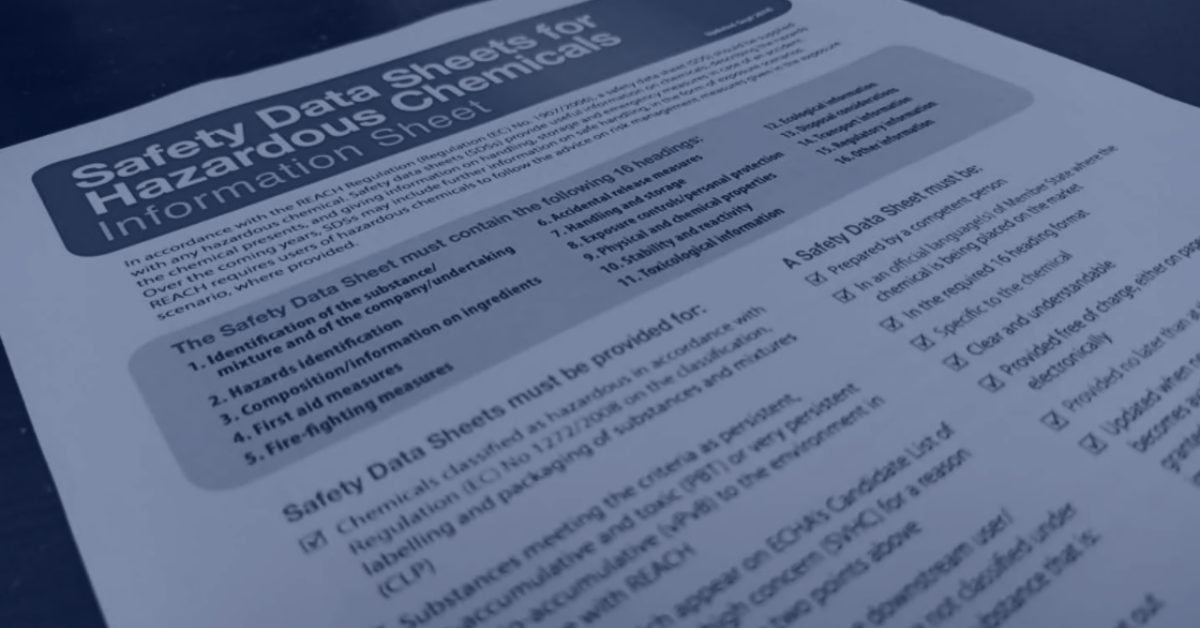
A Safety Data Sheet is not simply a health and safety communication. It is a legal instrument. It represents your organisation's formal declaration of how a product is classified, what hazards it presents, and how those hazards should be managed. If that declaration is wrong, the consequences extend well beyond a regulatory infringement notice.
Downstream customers rely on your SDS to meet their own obligations under REACH, GHS, and sector-specific requirements. Supply chain partners use it to make procurement and logistics decisions. In the event of a product liability dispute, it becomes a primary document. An SDS that cannot withstand scrutiny is a liability that compounds over time.
The most common compliance gaps we identify are not dramatic failures. They are systemic: a classification that predates a GHS revision; a transport section that references an obsolete UN entry; a mixture calculation that has drifted from the current formula. Each one is invisible to anyone who is not actively looking for it. Together, they represent a defensibility problem that grows with every regulatory cycle.
Why standard review cycles are not enough
The conventional response to SDS compliance risk is a periodic review programme, typically annual or biennial. For a large product portfolio, that means significant internal resource or a substantial external commitment, and the reviews are often shaped by what is convenient rather than what is high-risk.
The result is a library that has been reviewed but not necessarily interrogated. Documents that passed a check against last year's requirements may not pass a check against this year's. And the gaps that matter most, the ones with regulatory, commercial, or legal consequences, are rarely the ones that surface in a general review.
What is needed is a fast, targeted diagnostic that identifies where the real risk sits, so that remediation effort can be directed precisely.
What a rapid SDS diagnostic actually looks like
A well-designed SDS diagnostic is not a full audit. It is a structured sample review, conducted by regulatory scientists with current knowledge of GHS adoption timelines, CLP classification criteria, jurisdiction-specific requirements, and substance-specific developments including PFAS, SVHCs, and restricted substances lists.
The output is a prioritised findings report: not a list of observations, but a clear assessment of which gaps carry regulatory significance, which affect downstream compliance obligations, and which should be remediated first. Delivered within five working days, it gives compliance teams the intelligence they need to make an informed decision about the state of their library, without committing to a full remediation programme before they know the scale of the problem.
At Yordas by 3E, we call this an SDS Health Check. It is the first step in building a defensible compliance position, and it is where most of our SDS remediation engagements begin.
The case for acting now
Regulatory enforcement patterns suggest that SDS compliance is receiving increasing attention from national competent authorities, particularly in relation to GHS revision alignment and PFAS-related classification obligations. Companies that can demonstrate a current, well-maintained SDS library are in a materially stronger position, both with regulators and with the downstream customers who increasingly require evidence of compliance as a condition of supply.
The cost of getting this right is far lower than the cost of getting it wrong at the point of enforcement. A fast diagnostic is the most efficient way to find out which category you are in.
Yordas by 3E is offering a free SDS Health Check to a limited number of companies this quarter. We will review a sample of your SDS library against current regulatory requirements, identify any material gaps, and provide a prioritised findings report, with no obligation.
Book your free SDS Health Check today. Talk to a regulatory scientist who can tell you, quickly, where you stand.
FAQs
-
An SDS Health Check is a rapid, structured review of a sample of your Safety Data Sheet library, conducted by regulatory scientists against current GHS, CLP, and jurisdiction-specific requirements. It identifies compliance gaps, classification inconsistencies, and downstream risk, and delivers a prioritised findings report within five working days.
-
SDS compliance is not a fixed state. Regulatory frameworks including GHS revisions, CLP classification updates, and substance-specific obligations such as PFAS requirements change regularly. An SDS that was compliant when it was authored may no longer meet current requirements. The only reliable way to know is an independent review against current regulations.
-
The most common issues are not dramatic failures. They tend to be systemic: classifications that predate a GHS revision, transport sections referencing obsolete UN entries, mixture calculations that no longer reflect current formulas, and section content that has not been updated to reflect changes in CLP guidance or substance restrictions. These errors are invisible to the untrained eye but create real legal and commercial exposure.
-
A Safety Data Sheet is a legal instrument. Downstream customers rely on it to meet their own compliance obligations. Supply chain partners use it to make procurement and logistics decisions. In a product liability dispute, it becomes a primary document. Non-compliant SDS documents affect insurance positions, supply chain relationships, and regulatory defensibility.
-
A full SDS library audit can take weeks depending on portfolio size. The Yordas by 3E SDS Health Check is designed for speed: a sample review of up to X documents with a prioritised findings report delivered within five working days.
-
A full audit reviews every document in a library against a comprehensive set of requirements. An SDS Health Check is a targeted diagnostic: a structured sample review designed to identify where the material risk sits quickly, so remediation effort can be directed to the right places without committing to a full programme before understanding the scale of the problem.
-
Any company that manufactures, imports, or distributes chemical products and has not conducted an independent SDS review in the last 12 to 18 months. It is particularly relevant for companies operating across multiple jurisdictions, those with large or ageing SDS libraries, and those facing increased scrutiny from downstream customers or regulators.
-
Yordas by 3E is offering the SDS Health Check as a free taster to a limited number of companies. There is no commitment and no obligation.

Fiona Moir | Managing Regulatory Consultant • Hazard Communication
I head up the Hazard Communication team where we cover all of our SDS, classification, labelling and packaging services. Part of this service comprises the compilation of Safety Data Sheets (SDS) in accordance with global regulations.
I wear multiple hats, from the delivery and ongoing development of service structure, operations and training (internal and external). I also work with multiple departments to help with the development of the Hazel SDS and classification tools (Internal use) and the Helix SDS Manager.
Further reading



References
1. Deloitte and The Manufacturing Institute (2021), Creating Pathways for Tomorrow's Workforce Today: Beyond Reskilling in Manufacturing. themanufacturinginstitute.org
2. OECD (2025), OECD Employment Outlook 2025: Can We Get Through the Demographic Crunch? oecd.org
3. Cefic, Facts and Figures of the European Chemical Industry. cefic.org
4. Cefic, Landscape of the Industry: United Kingdom. cefic.org
5. Chemical Industries Association, People and Skills. cia.org.uk
6. IChemE (2026), Employment Survey 2025 results. icheme.org