August 4, 2026 by Fiona Moir
With the KKDIK temporary registration deadline of 30 September 2026 now nine weeks away, regulatory teams across Turkey and internationally are under real-time pressure. The requirement is unambiguous: every company manufacturing or importing chemical substances into Turkey must hold either a full or a temporary KKDIK registration number by that date, regardless of tonnage band, hazard classification, or whether a Lead Registrant has been appointed. From 30 September, the Turkish customs system will verify KKDIK registration numbers in real time. Substances without a valid number will be barred from the market.
What is less well understood - and what is creating a hidden pinch point for many companies - is the relationship between registration and Safety Data Sheet compliance. They are not two separate workstreams. They are interdependent.
The SDS requirement under KKDIK
Since 1 January 2024, any SDS authored for the Turkish market must be prepared in full compliance with KKDIK Annex II. The requirements are specific and non-negotiable: the document must be written in Turkish, cover all 16 mandatory sections, be authored by a certified Chemical Assessment Expert (KDU) approved by the MoEUCC, and be uploaded to the Ministry's designated SDS portal.
Critically, the SDS must also carry the KKDIK registration number of the substance it covers. This is not an administrative detail. It means that a company cannot simply finalise its SDS independently of its registration process. The two must be managed in parallel, with the SDS updated to reflect the registration number once it is issued.
For companies that have been operating with SDS documents prepared under the previous Turkish Regulation No. 29204, the picture is more complicated still. Those documents may still be considered valid if no mandatory update trigger has been met -- but any of the following will require a fully KKDIK-compliant replacement:
A change in the structure of the chemical substance
New hazard data or risk management information becoming available
Expiry of the authoring specialist's certificate
The granting or refusal of an authorisation, or imposition of a restriction
KKDIK registration is a substance obligation, but the compliance impact often extends to mixtures. If a substance contained within your mixtures is subject to registration or SDS updates, those changes may need to be reflected in every Turkish SDS for products that contain it. Reviewing substance registrations in isolation risks missing consequential updates across your wider portfolio.
Given that the registration process itself generates new regulatory status information, companies progressing through KKDIK registration should treat their legacy SDS documents as needing review as a matter of course. Many organisations assume that because an SDS already exists in Turkish, it is compliant. That is frequently not the case.
Two audiences, one deadline
For Turkish manufacturers, the September deadline creates a dual operational challenge: securing registration numbers across a potentially large substance portfolio while simultaneously ensuring that every corresponding SDS is Annex II compliant, KDU-certified, portal-uploaded, and registration-number-bearing.
For international companies supplying into Turkey -- European or global manufacturers, formulators, and distributors -- the stakes are equally direct. Supplying a hazardous substance or mixture into Turkey without a KKDIK registration number and a compliant SDS is not a documentation gap that can be remediated after the fact. It is a market access barrier that takes effect immediately.
For both audiences, the September 30 deadline is not the end of the KKDIK compliance journey. Companies in the highest tonnage bands -- substances manufactured or imported at 1,000 tonnes per annum or more, CMR substances above 1 tonne, and highly aquatic toxic substances above 100 tonnes -- face a full registration deadline of 31 December 2026. Dossier evaluation and the process for identifying Substances of Very High Concern both commence on that same date. The SDS implications of those processes, particularly around exposure scenarios and downstream user communication, will generate further update obligations before the year is out.
What to do now
With ten weeks to 30 September, the practical priorities are clear. Audit your substance portfolio against KKDIK registration requirements and confirm whether temporary or full registration is achievable in the time available. Review your current SDS documents to identify which were authored before 1 January 2024, which have since been updated and therefore require Annex II compliance, and which are not yet on the Ministry's SDS portal. Treat SDS authorship and registration as a single workstream, not two separate projects.
At Yordas Group, our in-house Chemical Assessment Specialists and KKDIK Only Representative team support both Turkish manufacturers and international companies supplying into Turkey. We provide SDS authorship and update services under KKDIK Annex II alongside full and temporary registration support, so your compliance position is coherent across both obligations before the September deadline.
Get in touch with our team at to arrange an initial assessment.
FAQs
-
Any SDS prepared for the Turkish market from 1 January 2024 must comply with Annex II of the KKDIK Regulation. It must be written in Turkish, cover all 16 mandatory sections, be authored by a certified Chemical Assessment Expert (KDU) approved by the MoEUCC, carry the KKDIK registration number of the substance, and be uploaded to the Ministry's designated SDS portal.
-
Only in limited circumstances. SDS documents prepared under Regulation No. 29204 before 1 January 2024 remain valid until a mandatory update trigger is met. Those triggers include a change in substance structure, new hazard or risk management information becoming available, expiry of the authoring specialist's certificate, or changes arising from an authorisation or restriction decision. Once any trigger is met, a fully KKDIK-compliant SDS must be prepared from scratch by a KDU-certified specialist.
-
A KDU (Kimyasal Değerlendirme Uzmanı, or Chemical Assessment Expert) is a specialist certified by the Turkish MoEUCC to author SDS documents under KKDIK. Any SDS that is not prepared or verified by a KDU is considered invalid under the regulation. This certification requirement applies to all SDS authored from 1 January 2024.
-
Yes. Under the 2025 KKDIK Procedures and Principles, the SDS must include the KKDIK registration number of the substance alongside the contact details and certification number of the authoring KDU. This means the SDS cannot be fully finalised until a registration number has been issued, and must be updated to reflect it once registration is complete.
-
A non-compliant SDS directly affects your ability to complete KKDIK registration, because the SDS must carry your registration number and be uploaded to the Ministry portal as part of the process. Beyond registration, non-compliant or missing SDS documents can result in fines, suspension of market access, and product withdrawal in Turkey.
-
Yes. All SDS prepared under KKDIK Annex II must be uploaded to the Ministry of Environment, Urbanisation and Climate Change's designated SDS portal by the supplier. The portal ensures traceability, version control, and regulatory oversight. SDS documents that have not been uploaded are not considered fully compliant, regardless of their content.
-
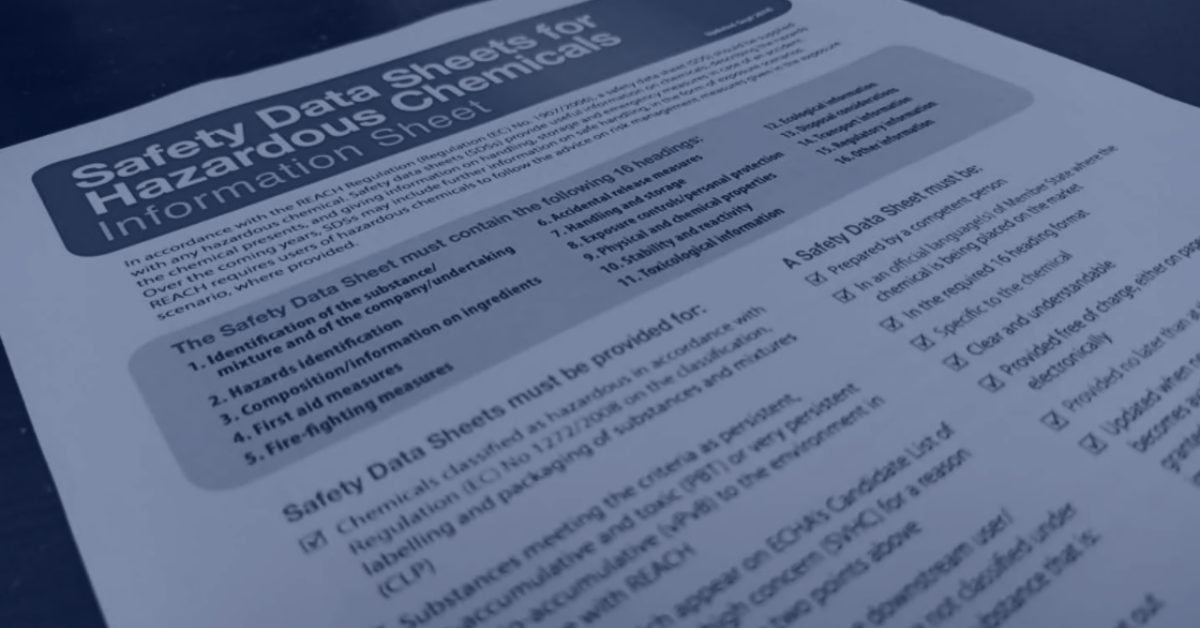
A KKDIK-compliant SDS must follow the structure set out in Annex II of the regulation, covering identification of the substance or mixture, hazard identification, composition and information on ingredients, first aid measures, firefighting measures, accidental release measures, handling and storage, exposure controls and personal protection, physical and chemical properties, stability and reactivity, toxicological information, ecological
-
Yes. The SDS must be written in Turkish. This applies to all 16 sections of the document. Study summaries, Chemical Safety Reports, and Exposure Scenarios attached to or referenced by the SDS must also be in Turkish.
-
The obligation to provide a compliant SDS sits with the supplier placing the substance or mixture on the Turkish market. For companies based outside Turkey, this responsibility typically sits with the KKDIK Only Representative appointed on behalf of the non-Turkish manufacturer. Turkish importers and distributors passing substances down the supply chain must also ensure that the SDS they provide to downstream users is KKDIK-compliant.
-
Yordas Group provides SDS authorship and update services for the Turkish market through in-house Chemical Assessment Specialists certified under KKDIK. We can assess your existing SDS portfolio, identify documents that require updating or full replacement, prepare compliant SDS under Annex II, and manage portal submission on your behalf. With the 30 September 2026 registration deadline approaching, now is the time to ensure your SDS position is in order. Get in touch at yordasgroup.com/contact.

Fiona Moir | Managing Regulatory Consultant • Hazard Communication
I head up the Hazard Communication team where we cover all of our SDS, classification, labelling and packaging services. Part of this service comprises the compilation of Safety Data Sheets (SDS) in accordance with global regulations.
I wear multiple hats, from the delivery and ongoing development of service structure, operations and training (internal and external). I also work with multiple departments to help with the development of the Hazel SDS and classification tools (Internal use) and the Helix SDS Manager.
Further reading



References
1. Deloitte and The Manufacturing Institute (2021), Creating Pathways for Tomorrow's Workforce Today: Beyond Reskilling in Manufacturing. themanufacturinginstitute.org
2. OECD (2025), OECD Employment Outlook 2025: Can We Get Through the Demographic Crunch? oecd.org
3. Cefic, Facts and Figures of the European Chemical Industry. cefic.org
4. Cefic, Landscape of the Industry: United Kingdom. cefic.org
5. Chemical Industries Association, People and Skills. cia.org.uk
6. IChemE (2026), Employment Survey 2025 results. icheme.org